 Case Study
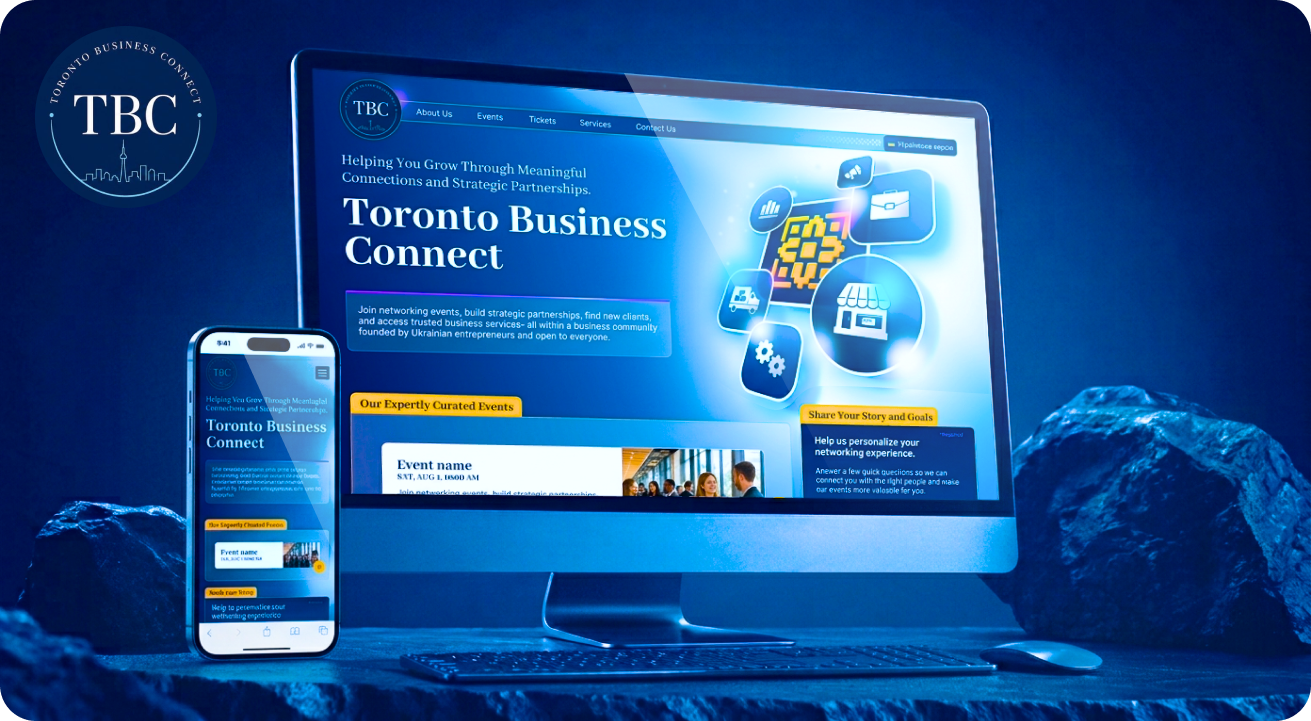
TBC Website - Personalized Business Community Experience
To help a growing Ukrainian business community better serve its members, I conducted user research to uncover their goals, challenges, and expectations. Through stakeholder interviews, 5 in-depth user interviews, and affinity mapping, I identified opportunities for more personalized networking, business support, and educational resources. These insights informed a research-backed website strategy and user experience designed to better match members with relevant opportunities, increase engagement, and provide a scalable foundation for long-term community growth.
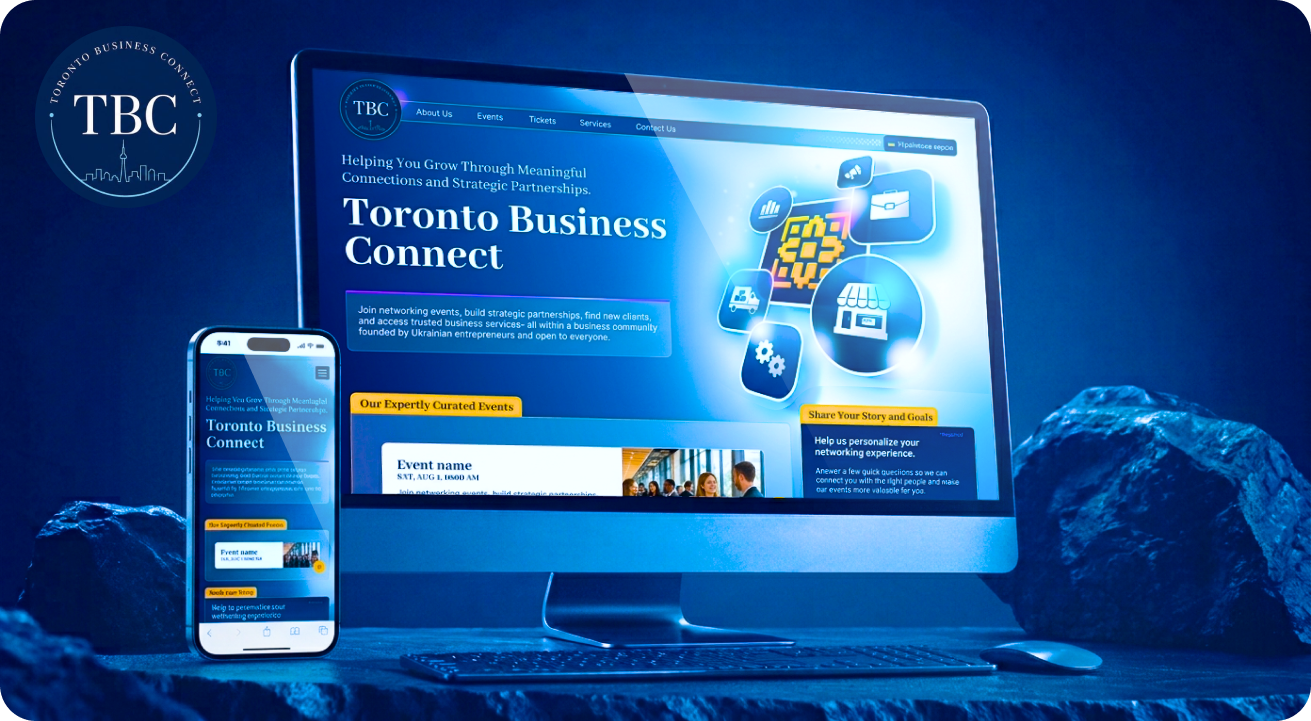
TBC Website - Personalized Business Community Experience
To help a growing Ukrainian business community better serve its members, I conducted user research to uncover their goals, challenges, and expectations. Through stakeholder interviews, 5 in-depth user interviews, and affinity mapping, I identified opportunities for more personalized networking, business support, and educational resources. These insights informed a research-backed website strategy and user experience designed to better match members with relevant opportunities, increase engagement, and provide a scalable foundation for long-term community growth.
Product Vision
The business framework will include:
- More relevant networking opportunities
- Better business partner matching
- Practical educational resources
- Guidance for starting and growing a business
The business framework will include:
- More relevant networking opportunities
- Better business partner matching
- Practical educational resources
- Guidance for starting and growing a business
Target Audience

Alex
Independent Entrepreneur
A freelancer or small business owner looking to grow his network and business.
Goals
- Find new clients and business partners
- Build valuable professional connections
- Learn practical strategies to grow their business
Challenges
- Struggles to consistently find new clients
- Has limited visibility in the market
Current Behavior
- Uses Facebook groups, Instagram, and Telegram communities
- Attends random networking events and Meetup gatherings
- Relies on cold outreach and personal referrals to find opportunities

Sarah
Small Business Owner
An owner of a growing small business looking to expand her reach and grow sustainably.
Goals
- Scale their business and attract new clients
- Access trusted business services and expert support
- Increase brand awareness and market presence
Challenges
- Slow customer acquisition
- Limited marketing expertise and an outdated website
- Gaps in business knowledge and strategy
Current Behavior
- Relies on referrals and repeat customers
- Hires freelancers or agencies when budget allows
- Searches online for business advice, marketing resources, and local networking opportunities

Olena
Marketing Manager
A marketing manager looking to promote their products or services to a relevant audience.
Goals
- Reach their target audience directly
- Generate qualified leads and increase sales
- Strengthen brand awareness within their niche
Challenges
- Struggles to reach the right audience efficiently
- High customer acquisition costs through traditional advertising
Current Behavior
- Invests in digital advertising and social media campaigns
- Sponsors industry events and conferences
- Partners with business communities and professional organizations to generate leads
Research
5
User Interviews Conducted
1
Research-Backed Website Strategy Developed
To test the assumptions outlined in the Product Vision, we focused our research on entrepreneurs and freelancers as the primary target audience.
I conducted 5 in-depth user interviews to explore whether the hypothesized pain points were genuine and significant, how participants were currently addressing these challenges, and what they liked or disliked about their existing solutions. We also explored what types of networking opportunities, educational resources, and business services would provide enough value to make the proposed ecosystem worthwhile to them.
I synthesized the findings using affinity mapping to identify recurring pain points, needs, behaviors, and expectations. The research helped validate and refine our initial hypotheses and shaped a strategy focused on personalized networking, meaningful business connections, practical educational resources, and trusted business services to support entrepreneurs in their growth.
Questions asked:
-
- What do you do?
→Establishes the participant's business context, experience, and situation so their subsequent answers can be interpreted in context.
-
→Identifies the participant's most significant current business pain points and helps determine which problems are important enough to require support.
-
- What methods work best?
- Which methods are frustrating?
→Reveals how participants currently acquire customers, which approaches they rely on, and where they experience difficulties or dissatisfaction.
-
- How did you meet them?
- What came out of that connection?
→Reveals the value participants place on professional connections and how networking has—or has not—contributed to their business.
-
- How did you try to find them?
- How well did it work?
→Determines whether finding business partners or collaborators is a genuine need and reveals how effectively participants currently solve that need.
-
- Why or why not?
- What do you like about them?
- What do you dislike?
→Reveals participants' existing networking behaviors, motivations, and frustrations, helping identify what could make Ukrainian Business Hub's events more valuable than existing alternatives.
-
- What triggered that need?
- How did you solve it?
→Identifies which business services participants actually need, what triggers those needs, and how they currently address them.
-
→Helps identify the problems participants consider most urgent or impactful, revealing where the greatest perceived value may lie.
-
- What would you expect to get out of it?
- What would make it a waste of time?
→Explores participants' desired outcomes and expectations from the proposed community, helping determine what value proposition would motivate them to participate and what could make the experience feel irrelevant or not worth their time.
5
User Interviews Conducted
1
Research-Backed Website Strategy Developed
To test the assumptions outlined in the Product Vision, we focused our research on entrepreneurs and freelancers as the primary target audience.
I conducted 5 in-depth user interviews to explore whether the hypothesized pain points were genuine and significant, how participants were currently addressing these challenges, and what they liked or disliked about their existing solutions. We also explored what types of networking opportunities, educational resources, and business services would provide enough value to make the proposed ecosystem worthwhile to them.
I synthesized the findings using affinity mapping to identify recurring pain points, needs, behaviors, and expectations. The research helped validate and refine our initial hypotheses and shaped a strategy focused on personalized networking, meaningful business connections, practical educational resources, and trusted business services to support entrepreneurs in their growth.
Questions asked:
-
- What do you do?
→Establishes the participant's business context, experience, and situation so their subsequent answers can be interpreted in context.
-
→Identifies the participant's most significant current business pain points and helps determine which problems are important enough to require support.
-
- What methods work best?
- Which methods are frustrating?
→Reveals how participants currently acquire customers, which approaches they rely on, and where they experience difficulties or dissatisfaction.
-
- How did you meet them?
- What came out of that connection?
→Reveals the value participants place on professional connections and how networking has—or has not—contributed to their business.
-
- How did you try to find them?
- How well did it work?
→Determines whether finding business partners or collaborators is a genuine need and reveals how effectively participants currently solve that need.
-
- Why or why not?
- What do you like about them?
- What do you dislike?
→Reveals participants' existing networking behaviors, motivations, and frustrations, helping identify what could make Ukrainian Business Hub's events more valuable than existing alternatives.
-
- What triggered that need?
- How did you solve it?
→Identifies which business services participants actually need, what triggers those needs, and how they currently address them.
-
→Helps identify the problems participants consider most urgent or impactful, revealing where the greatest perceived value may lie.
-
- What would you expect to get out of it?
- What would make it a waste of time?
→Explores participants' desired outcomes and expectations from the proposed community, helping determine what value proposition would motivate them to participate and what could make the experience feel irrelevant or not worth their time.
Insights
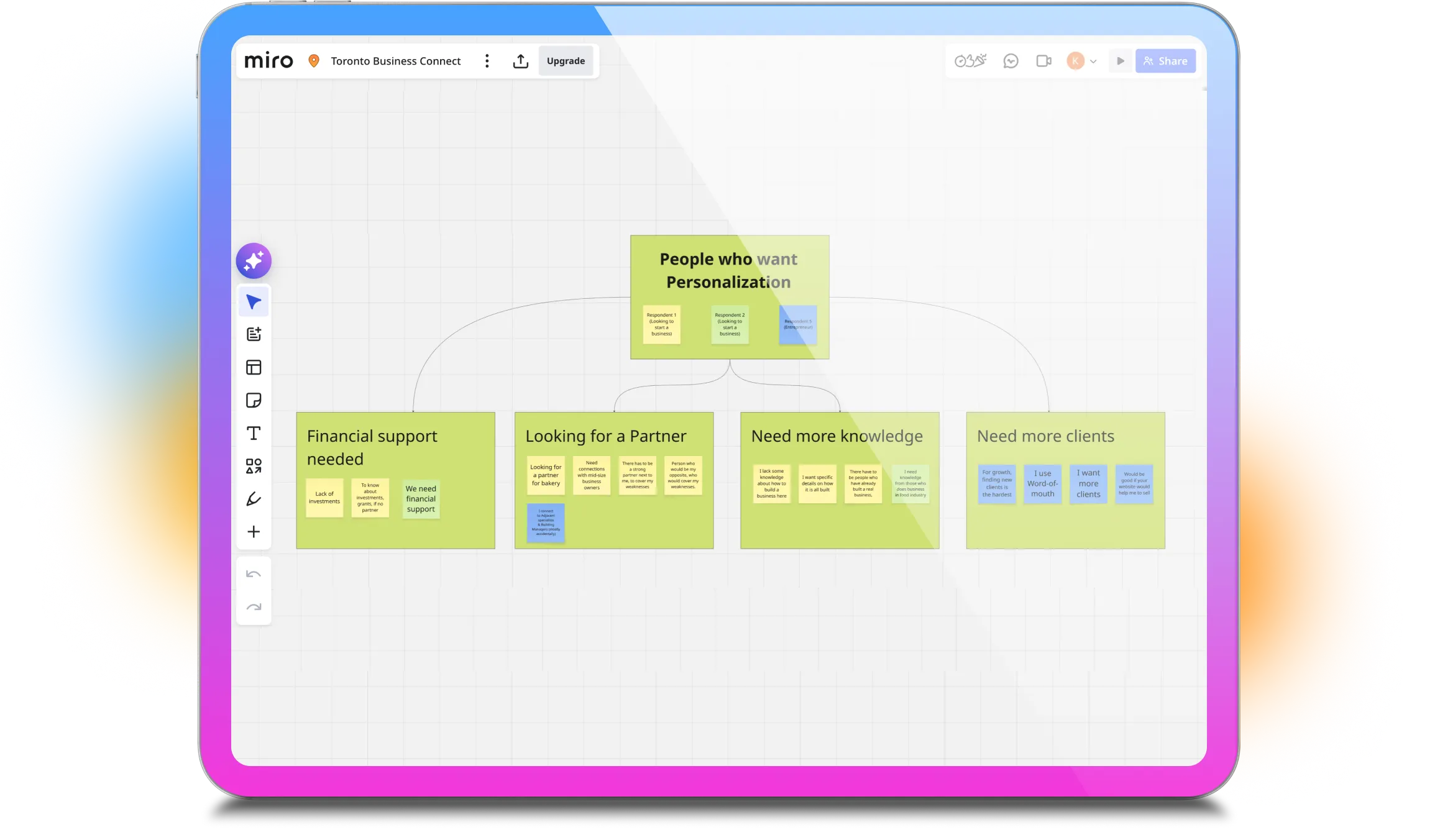
Affinity diagramming and Insights
I used affinity diagramming to synthesize the interview findings, grouping observations into meaningful themes and uncovering the underlying needs of the target audience. The analysis revealed several key insights, with personalization emerging as the strongest opportunity for improving the community experience.
Research revealed that members were looking for:
- More relevant networking opportunities
- Better business partner matching
- Practical educational resources
- Guidance for starting and growing a business
These insights directly informed the UX strategy, feature prioritization, and overall product direction.
Affinity diagramming and Insights
I used affinity diagramming to synthesize the interview findings, grouping observations into meaningful themes and uncovering the underlying needs of the target audience. The analysis revealed several key insights, with personalization emerging as the strongest opportunity for improving the community experience.
Research revealed that members were looking for:
- More relevant networking opportunities
- Better business partner matching
- Practical educational resources
- Guidance for starting and growing a business
These insights directly informed the UX strategy, feature prioritization, and overall product direction.
UX Strategy

TBC UX Strategy
Drawing on stakeholder input and research findings, I defined a UX strategy that positioned the platform as a personalized business ecosystem. The strategy established the vision, user experience principles, key features, and success metrics needed to support both community growth and business objectives.
Strategy Overview
- Product Vision - Define TBC as an all-in-one business ecosystem where entrepreneurs can network, learn, and access professional services to grow their businesses.
- Target Audience - Prioritize entrepreneurs, freelancers, and aspiring business owners based on stakeholder insights and research.
- Design Principles - Create a personalized, action-oriented, and trustworthy experience that minimizes friction and encourages meaningful engagement.
- Personalization Strategy - Match members with relevant people, events, content, and business opportunities based on their goals and interests.
- Core Features - Personalized onboarding, intelligent member matching, event ticketing, user dashboards, and a centralized business resource hub.
- Success Metrics - Measure meaningful connections, event participation, member retention, and user satisfaction to evaluate business and user outcomes.
- Implementation Roadmap - Deliver the platform in phased releases, validating assumptions through user feedback before expanding functionality.
TBC UX Strategy
Drawing on stakeholder input and research findings, I defined a UX strategy that positioned the platform as a personalized business ecosystem. The strategy established the vision, user experience principles, key features, and success metrics needed to support both community growth and business objectives.
Strategy Overview
- Product Vision - Define TBC as an all-in-one business ecosystem where entrepreneurs can network, learn, and access professional services to grow their businesses.
- Target Audience - Prioritize entrepreneurs, freelancers, and aspiring business owners based on stakeholder insights and research.
- Design Principles - Create a personalized, action-oriented, and trustworthy experience that minimizes friction and encourages meaningful engagement.
- Personalization Strategy - Match members with relevant people, events, content, and business opportunities based on their goals and interests.
- Core Features - Personalized onboarding, intelligent member matching, event ticketing, user dashboards, and a centralized business resource hub.
- Success Metrics - Measure meaningful connections, event participation, member retention, and user satisfaction to evaluate business and user outcomes.
- Implementation Roadmap - Deliver the platform in phased releases, validating assumptions through user feedback before expanding functionality.
Design System
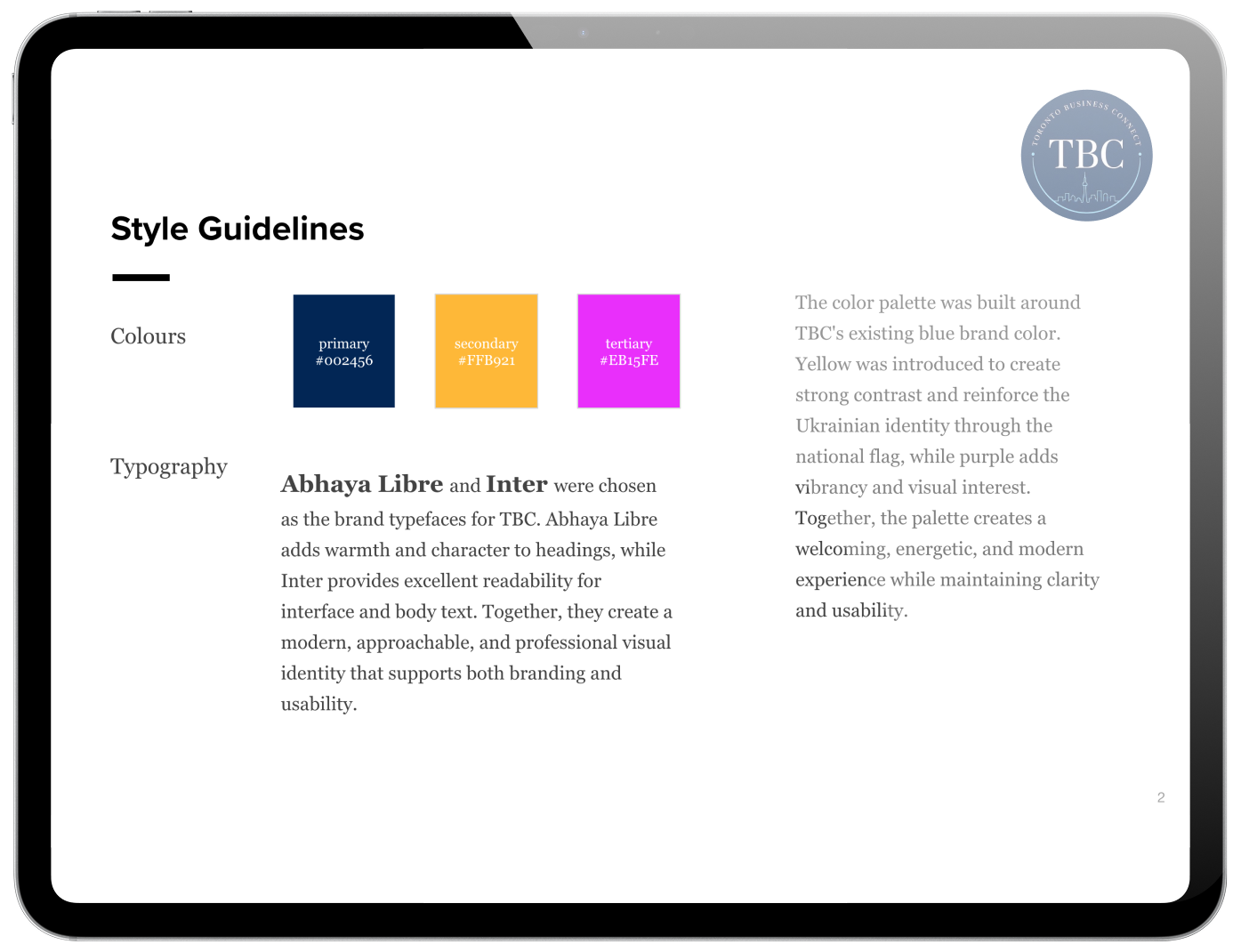

TBC Design System
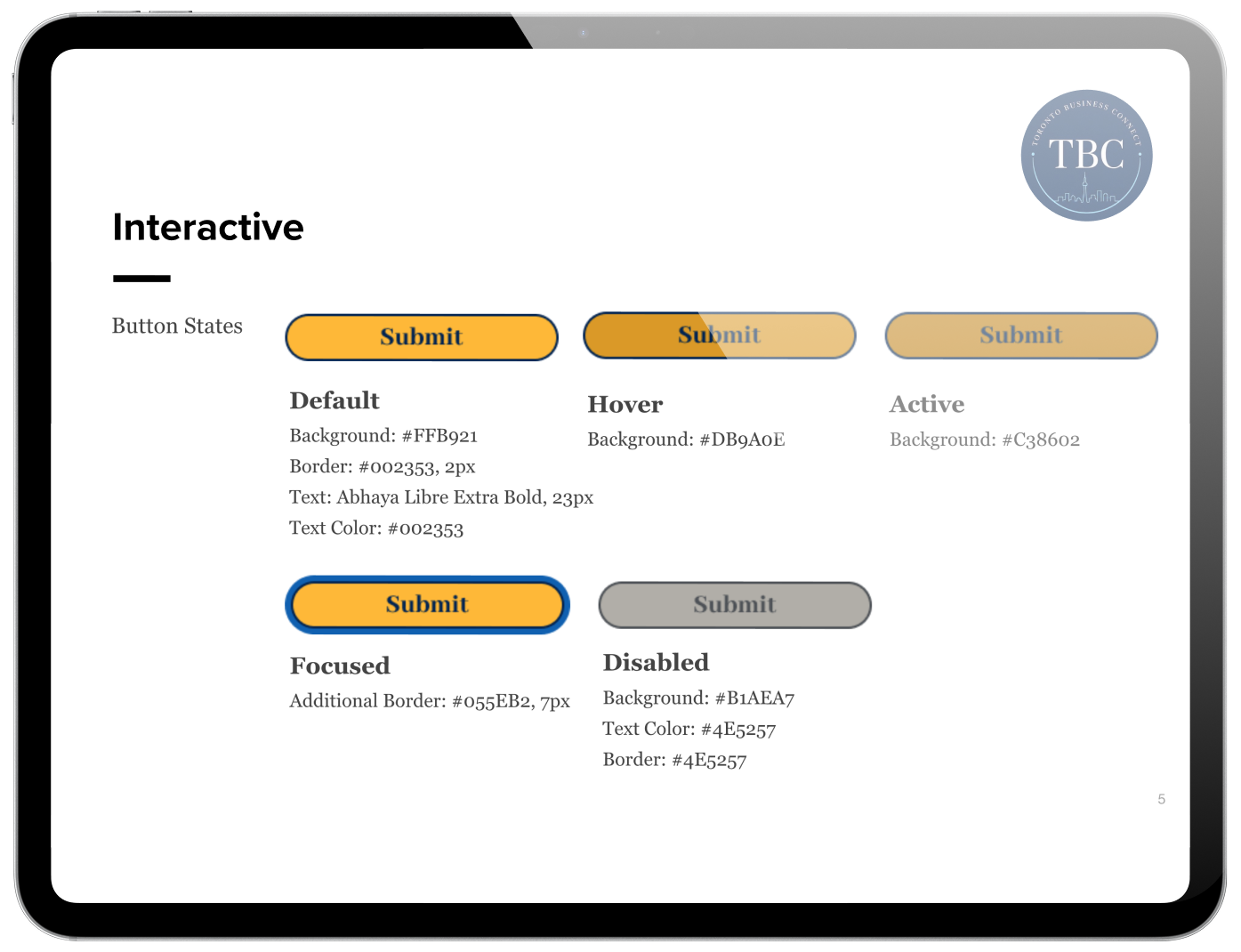
Building on the UX strategy, I created a design system that translated the product vision into a consistent and scalable user experience. It established the visual identity, typography, color palette, reusable UI components, and interaction states, ensuring consistency across the product while reducing design and development effort.
The design system provides a solid foundation for future growth, enabling new features to be designed and implemented more efficiently without compromising usability or brand consistency. As a living artifact, it evolves alongside the product and is continuously refined and expanded as new components, patterns, and requirements emerge.

TBC Design System
Building on the UX strategy, I created a design system that translated the product vision into a consistent and scalable user experience. It established the visual identity, typography, color palette, reusable UI components, and interaction states, ensuring consistency across the product while reducing design and development effort.
The design system provides a solid foundation for future growth, enabling new features to be designed and implemented more efficiently without compromising usability or brand consistency. As a living artifact, it evolves alongside the product and is continuously refined and expanded as new components, patterns, and requirements emerge.
Design Translation
Translating Research into Design
The website was designed with personalization as one of its core principles. Research revealed that members wanted more relevant connections, opportunities, and resources tailored to their individual goals rather than a one-size-fits-all community experience.
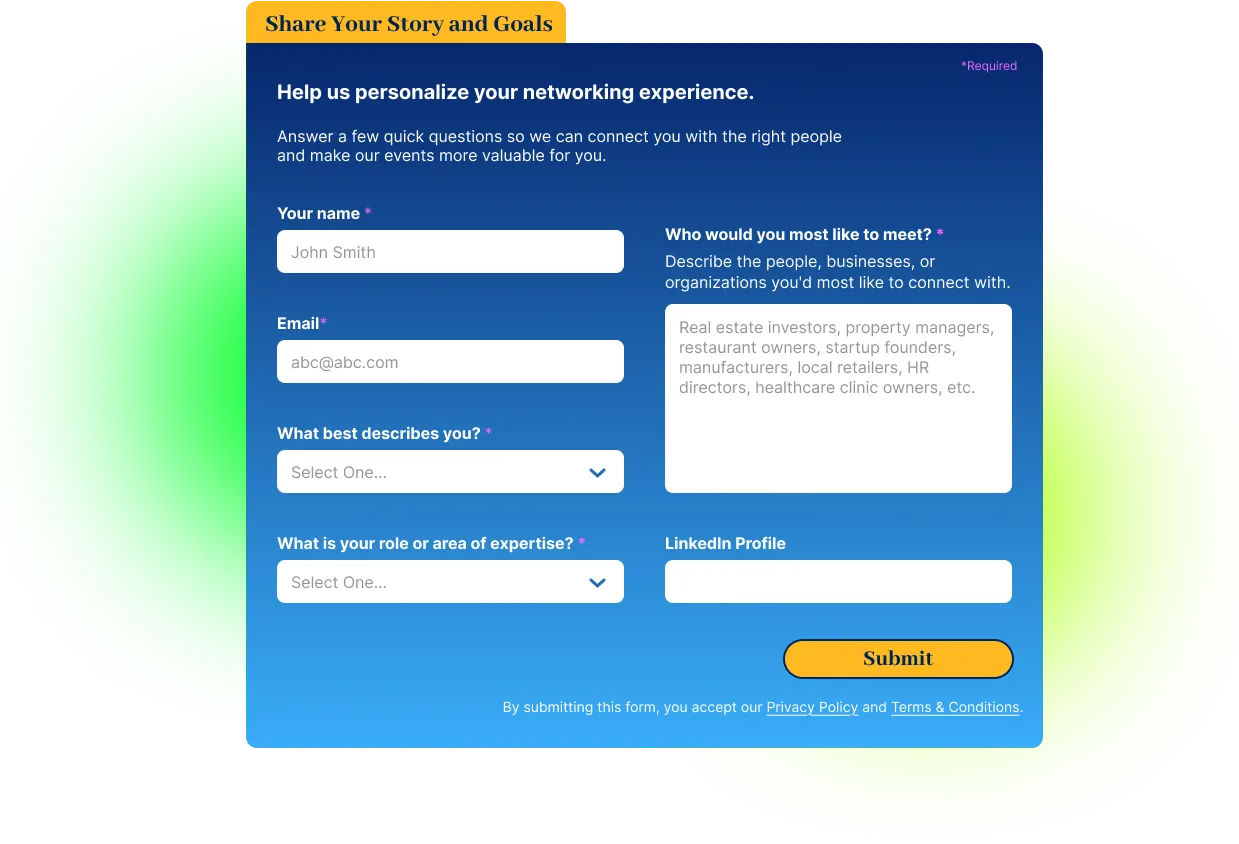
To support this, after brainstorming, we decided to begin the journey with a guided onboarding form that captures each member's goals, interests, and motivations. This information powers personalized recommendations for events, networking opportunities, business partners, and educational content, creating a community experience that becomes more relevant and valuable as members engage with the platform.
Translating Research into Design
The website was designed with personalization as one of its core principles. Research revealed that members wanted more relevant connections, opportunities, and resources tailored to their individual goals rather than a one-size-fits-all community experience.
To support this, after brainstorming, we decided to begin the journey with a guided onboarding form that captures each member's goals, interests, and motivations. This information powers personalized recommendations for events, networking opportunities, business partners, and educational content, creating a community experience that becomes more relevant and valuable as members engage with the platform.
The Result


 Email Me
 416.931.7752
 Book a Call